MASTER CLASS:
Designing FOR AI in customer experience and employee experience
An 8-week live online master class to help you make strategic decisions for integrating AI into your customer and employee experiences.
CLASS STARTS
TUESDAY, SEPTEMBER 10, 2024
85% of AI projects fail. Yours doesn't have to be one of them.
Customer experience pioneer Kerry Bodine and Carnegie Mellon University professor Dan Saffer will pull back the curtain on all the AI hype — and share a powerful combination of research-driven methodologies to make your AI-driven experience projects successful.
Registration is open!
Click the appropriate button below to register your attendees.
$3,000 for one attendee
$2,500 per person for two to three attendees (Save $500 per attendee)
$2,000 per person for four to five attendees (Save $1000 per attendee)
AI MYTHS
AI myth #1: AI = GenAI
Reality: While GenAI has received the lion’s share of press, AI encompasses a much broader set of capabilities that you can leverage to deliver value to your customers, employees, and stakeholders.
AI Myth #2: AI is superintelligent
Reality: Today’s AI systems are often quite stupid. But they’re also quite powerful when used appropriately in the right circumstances. The trick is figuring out which capabilities to leverage in which business contexts.
AI Myth #3: Traditional design processes work for AI
Reality: Research has proven that traditional human-centered design methods often result in AI concepts that are high-risk, impractical, and/or outside of today’s AI capabilities.
MASTER CLASS OVERVIEW
In this 8-week virtual master class, we'll bust the biggest myths in design for AI — and help you create effective AI solutions in a systematic and repeatable way. And yes, we'll go way beyond GenAI.
This master class is all about:

Developing strategies for viable and profitable AI initiatives
Designing AI-enabled experiences that provide value to customers and employees
Broadening your AI toolkit to utilize the full breadth of today's AI capabilities
De-risking AI initiatives through a set of structured methods and tools
Identifying the most effective AI initiatives for your organization to pursue right now
This master class is NOT about:
Executing AI projects at the interface level
Using AI for customer or employee research, ideation, prototyping, etc.
Designing experiences with AI tools (ChatGPT, Stable Diffusion, Figma, etc.)
Using GenAI to create images and text
AUDIENCE
We’ve designed this course to supercharge the AI savviness of business decision-makers from customer experience, marketing, product management, design, operations, sales, customer success, customer service, business process improvement, and human resources.
In other words, if you’re working on customer experience or employee experience improvement initiatives and want to develop or deepen your AI skill set, this course is for you.
You don’t need any technical knowledge of AI — just curiosity and a desire to propel your business and your people forward by maximizing what’s likely to be the most pivotal business technology that we’ll see in our lifetime.
TIME COMMITMENT
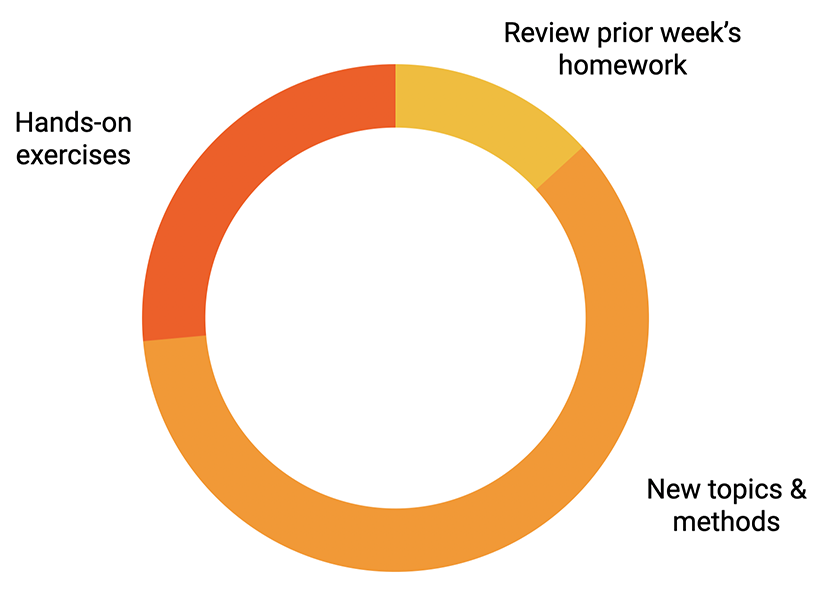
We'll meet live for 90 minutes every Tuesday for 8 weeks. In addition to our live sessions, participants should plan to spend approximately one to two hours each week on independent homework activities.
CLASS STRUCTURE
Classes will be held at 11am ET on Tuesdays, giving you three subsequent work days to complete your independent homework activities.
BENEFITS OF OUR FORMAT
We’ve designed our program to benefit you and your organization in the following ways:
Convenient: Our 90-minute weekly sessions fit into your busy schedule and work commitments.
Practical: You’ll get hands-on experience with research-backed methods and tools for designing for AI.
Applicable: We’ll dive into real-world scenarios that are relevant across myriad business contexts.
Paced: Our 8-week program gives you ample time to absorb each lesson — and immediately put your learnings into practice within your organization.
Collaborative: You’ll learn from the challenges and successes of peers at other organizations.
Recorded: Should you need to miss a session — or just want to revisit certain topics — class recordings will be available for 6 months after the completion of the master class.
You can put AI in anything.
But that doesn't guarantee it will be valuable.
This master class delivers a robust, research-backed methodology for finding practical, low-risk AI solutions that add value for customers, employees, and your business.
YOUR INSTRUCTORS

Kerry Bodine
Co-author of Outside In

DaN SAFfER
Professor at Carnegie Mellon University
Kerry Bodine
Kerry Bodine’s book, Outside In: The Power of Putting Customers at the Center of Your Business, helps business leaders understand the financial benefits of great customer experiences — and how their organizations must change in order to deliver them.
In 2014, she founded Bodine & Co., a customer experience consulting firm focused on helping organizations fundamentally shift to thinking and working in more customer-centric ways. She’s also a frequent keynote speaker at conferences and facilitator at private corporate events around the world.
Kerry’s ideas, analysis, and expert opinions have appeared on sites like The Wall Street Journal, Harvard Business Review, Fast Company, Forbes, and USA Today. She holds a master’s degree in human-computer interaction from Carnegie Mellon University.
Dan Saffer
Dan Saffer is an Assistant Professor of the Practice at the Human-Computer Interaction Institute at Carnegie Mellon University, a product design leader, and the author of four books: Designing Devices, Designing Gestural Interfaces, Designing for Interaction, and the best-selling Microinteractions.
Since 1995, he's designed devices, apps, websites, wearables, appliances, automotive interiors, services, social networks, and robots. He’s worked at and for such companies as Twitter, Smart Design, Samsung, Jawbone, CNN, Philips, and Microsoft — and was most recently Head of Product Design at Flipboard.
He graduated from Carnegie Mellon with a Master’s in Design, Interaction Design.
SYLLABUS & SCHEDULE
September 10
Why most AI projects fail
You read that correctly: Most AI projects fail. 85% of them, in fact, according to Harvard Business Review. That means most organizations are wasting time and valuable resources on AI products and services that no one wants, that bring no value to customers or the organization, and that are riddled with ethical issues. And when failure happens, if it’s bad enough, you’ll hear about it in the news. When AI projects do succeed, they’re usually one-off unicorns, created more by accident than intention. As a result, they’re unlikely to be repeated. Fortunately, this is completely avoidable using the right combination of methods and tools up front, before a single line of code or a single piece of data has been collected.
September 17
The 8 core AI capabilities you need to know
If you spend any time reading the news or scrolling through social media feeds, it’s easy to assume that GenAI is the only type of AI that exists. But generation of text, images, code, etc. is just one of eight core AI capabilities that organizations have at their disposal. We’ll broaden your AI toolkit with a deep dive into each of these capabilities, demonstrating how you can leverage them today to improve and streamline your customer and employee experiences. We’ll provide in-depth examples of each capability and break them down into basic actions and the effects each can achieve.
September 24
MATCHMAKING
If you’re already steeped in human-centered design, this is where things might get uncomfortable. That’s because research has proven that traditional human-centered design methods — including ideation based on people’s needs and pain points — inevitably lead teams to solutions that are either too challenging or simply inappropriate for AI. And, on the flipside, these traditional processes fail to identify opportunities for low-risk, high-reward AI innovations. (Just to repeat, this is why most AI projects fail.) You’ll learn a research-vetted approach for generating AI solutions that starts with broad customer and employee contexts and applies the eight core capabilities in a structured way.
October 1
Rapid evaluation of AI concepts
We’ll introduce a multi-layered set of filters that will enable you to quickly weed out high-risk AI solutions that either require too much expertise (think medical imaging analysis) and/or too much accuracy (think biometric security) to be commercially viable for most organizations and AI development teams. But we won’t throw those potential solutions away. Instead, we’ll apply a three-part framework for modifying these solutions in ways that pull them into the AI sweet spot.
October 7
Ensuring value to YOUR customers, employees, and organization
The unpredictable nature of AI requires teams to flip the script of traditional experience design processes by putting what’s possible and realistic ahead of what people and organizations actually need. (Believe us, this hurts our brains, too.) But we don’t ignore the needs of people and organizations for long! After we’ve identified potential solutions that live in the AI sweet spot, we’ll put them through two additional filters to determine if these ideas actually solve one or more real-world needs for your customers, employees, and stakeholders.
October 15
BREAK WEEK
Enjoy your break!
October 22
Consequence scanning
By now you’ve heard countless stories of AI initiatives that cause harm to customers, employees, brands — not to mention the greater society in which we live. These ethical horror stories stem from the fact that AI operates in uncertain contexts with sometimes unpredictable outcomes — and many teams fail to consider what will happen even if the AI acts exactly as predicted. (Especially if the AI acts as predicted!) Consequence scanning is a tool for envisioning a future state in which the product or feature is launched and people have begun to use it. We’ll take you through a two-part method to first identify unforeseen consequences (both the good and bad) and then resolve negative consequences where possible.
October 29
identifying your best ai concept
The process we’ll take you through up to this point will generate multiple possible AI solutions that live in the sweet spot of being low-risk and high value. But which of these are the best solutions? Which ones should you actually prioritize to move forward into development? And how do you justify those decisions? We’ll introduce two frameworks for a more detailed assessment of your solutions’ technical and financial feasibility that will promote discussion and internal alignment.
November 5
WHAT'S NEXT?
Our final session will dive into topics that will further drive a high degree of success within your AI strategic planning — such as who should be included in AI business and design decisions, how to put together a solid business case for your proposed AI solutions, and how to create accountability structures for when things go awry. We’ll also preview some of the questions you’re sure to face next: How do you actually prototype an AI system? How should you adapt as new data becomes available or as users provide feedback? How can you make your AI solutions adaptable and explainable? And how can you avoid creeping people out?
CUSTOM WORKshops & Keynotes
Interested in bringing Kerry or Dan to your organization to facilitate a strategic AI workshop with your leaders? Want us to inspire your employees, customers, or partners with an engaging keynote? We’ll tailor our content and exercises to answer your biggest AI questions and align with your most pressing business challenges.
COST
Designing for AI is a team sport: Researchers from Carnegie Mellon University have found that the most effective AI design teams include experience designers, data scientists, and business stakeholders. For that reason, we’ve priced our master class to be affordable for you and your team.
Pricing for colleagues from the same organization:
$3,000 for one attendee
$2,500 per person for two to three attendees (Save $500 per attendee)
$2,000 per person for four to five attendees (Save $1000 per attendee)
In order to create a balanced learning environment, we kindly ask that you register no more than 5 people from your organization. If you’re interested in providing training to more than five people, please reach out to discuss a custom training program for your organization.
Are you doing something good for the world? We offer a discount for non-profit organizations. Please get in touch to discuss reduced pricing.
REFUNDS
Once purchased, your registration fee is non-refundable.
Also, we’re nice humans, and we understand that things happen. So, if you’re not able to attend for any reason, we will happily transfer your spot to one of your colleagues — or apply your registration fee to a future master class.
A NOTE ON COURSE DISCUSSION TOPICS
Because of the unpredictable nature of AI and the biases inherent in many underlying data sets, our discussions will occasionally include sensitive topics including (but not limited to) racism, sexism, domestic violence, eating disorders, addiction, privacy, personal safety, illness, and death.
While we wish it wasn’t necessary to go into these conversation spaces, any comprehensive and realistic AI strategy today must acknowledge such potential ethical implications in order to reduce the risk of inflicting unintentional harm on people, organizations, and/or society.
By registering, you acknowledge that you are aware of these potential discussion topics and that you are willing to engage in productive conversations around them.
The future is here.
Join us.
Click the appropriate button below to register your attendees.
$3,000 for one attendee
$2,500 per person for two to three attendees (Save $500 per attendee)
$2,000 per person for four to five attendees (Save $1000 per attendee)